







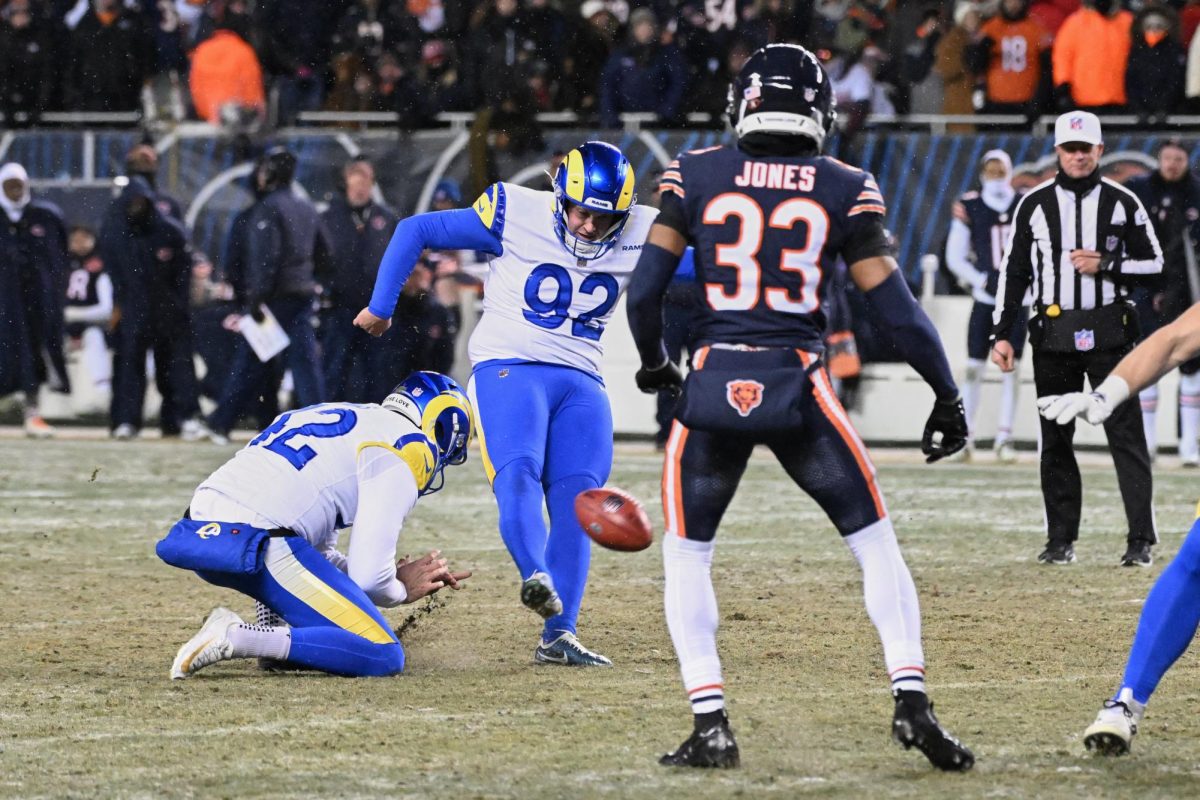

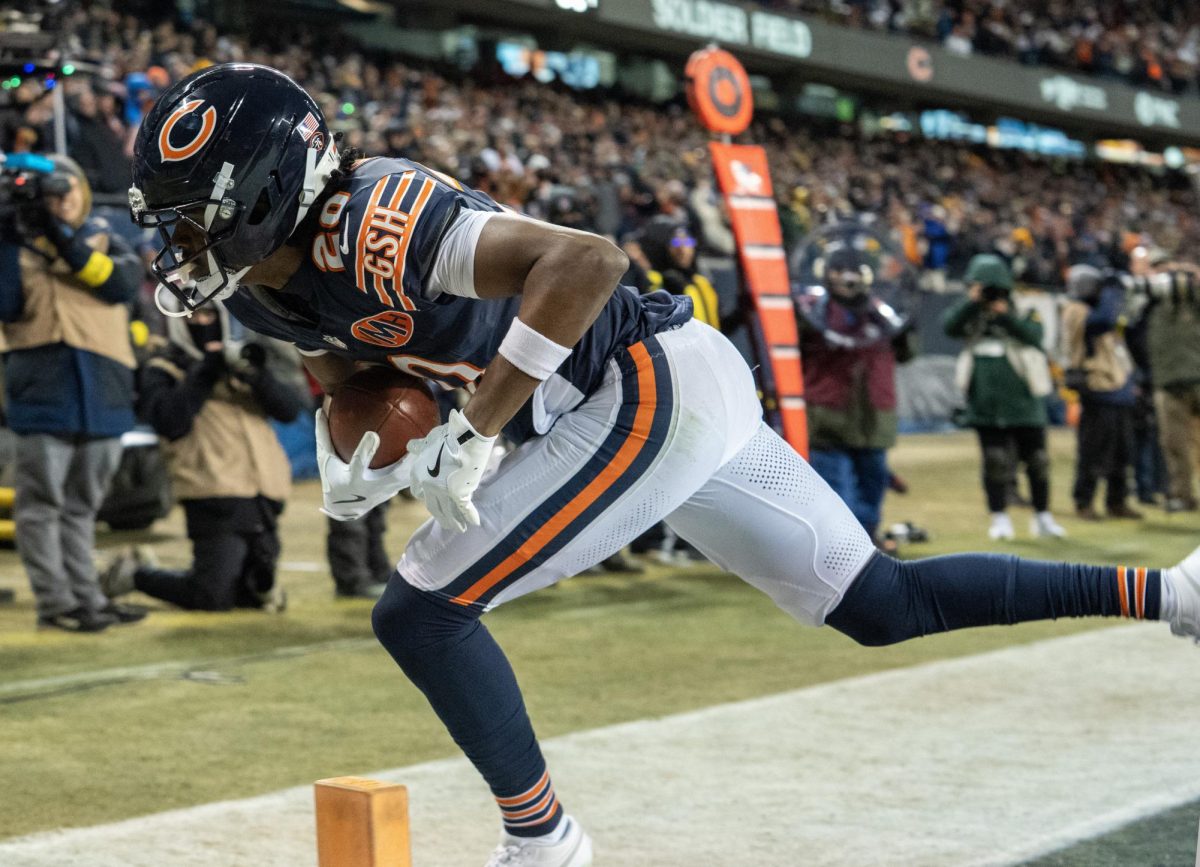







The Chicago Bears saw their season end in disappointing fashion on January 18 in an overtime loss to the Los Angeles Rams in the divisional round of the playoffs. Although it is sad that the 2025 Bears’ near-historic run has come to an end, fans should still be glad for the amazing season put together in Head Coach Ben Johnson’s first year and hopeful for next season. Below are the most important takeaways from this season.
Drafting Colston Loveland was the right choice.
On the night of the 2025 NFL draft, the Chicago Bears selected tight end Colston Loveland with the tenth overall pick. Four picks later, the Indianapolis Colts selected Tyler Warren, another highly ranked tight end prospect. Many Bears fans thought the team made the wrong decision, and for the first half of the season, they seemed to be right. In the first eight weeks of the season, Warren had 37 receptions for 492 yards, compared to Loveland’s 116 yards on 11 catches. By the end of the season however, Loveland had mostly caught up to Warren. Loveland ended with 58 receptions for 713 yards, while Warren had 76 receptions for 817 yards. Loveland caught six touchdowns to Warren’s four. As the season went on, the Bears finally made use of Loveland in the way they should have been all season, with him finishing the season as the team’s leading receiver. It is clear that despite the slow start, Loveland will continue to be a major part of the Bears’ offense for years to come.
The Bears’ offensive line deserves more credit.
The Bears certainly would not have had the season that they did if not for their formidable offensive line, a significant improvement from last year. According to Pro Football Focus (PFF), the unit gave up 37 sacks in 2024, the most in the league, while in 2025 they only allowed 13. They also ranked top ten in the league for both run and pass blocking efficiency rating, according to PFF. A significant focus of the offseason last year was trying to fix the offensive line issues that plagued the team in 2024. The Bears traded for guards Jonah Jackson and Joe Thuney in the offseason, signed center Drew Dalman in free agency, and drafted left tackle Ozzy Trapilo in the second round of the 2025 draft. This left only one starting player remaining from the 2024 offensive line, right tackle Darnell Wright. It was this revamp that largely allowed for the explosion in the Bears’ rushing attack, allowing them to finish near the top of the league in rushing years.
Kyle Monangai was the biggest draft steal.
The offensive line isn’t the only reason the Bears took such a step forward in the run game this year. Kyle Monangai was the final draft pick for the Bears in the 2025 NFL draft. Seventh round picks like Monangai rarely see significant regular season action, especially in their first season. Despite this, Monangai proved to be an integral part of the Bears’ offense as the season went on. He finished the year with 783 rushing yards and added 164 through the air. Monangai introduced another dimension to the Bears’ strong rushing attack, complementing Deandre Swift’s quick agility with his own powerful rushing style. Next year, this running back tandem is expected to continue to flourish under Head Coach Ben Johnson’s creative play-calling.
The Bears’ path to the 2025 divisional is not sustainable.
The story of the 2025 Bears was one defined by wild comebacks, huge games, and exciting storylines. Improving from 5-12 to 11-6 in one season is truly impressive, but the team was still not perfect. They will not be able to continue their success next year without making a few changes. Firstly, while the defense excelled at causing turnovers, it struggled with giving up yardage to opponents. According to Team Rankings, it allowed fourth-most yards to opponents, with 363.7 yards allowed per game. At the same time, it averaged 1.7 takeaways per game, the third-most in the NFL. This meant that the team was able to mask its poor overall performance by handing the ball to its high performing offense. While this formula seemed to work this year, it caused some issues when the defense was required to hold steady in high pressure situations, or when it wasn’t forcing enough turnovers. The Bears defense needs to play more conservatively next year, worrying more about giving up field position than causing turnovers. Second, the Bears won seven of their games by fourth quarter comebacks, something that many would deem unsustainable. While some would point to this as a sign of the team’s strength in playing under pressure, just a few slight changes in many of these games could have been the difference between a win and a loss. If the Bears want to have success into the future, consistent performance needs to be a major theme this offseason, and they need to focus on not putting themselves in fourth quarter deficits as often as they did this year.