







SPOILERS AHEAD
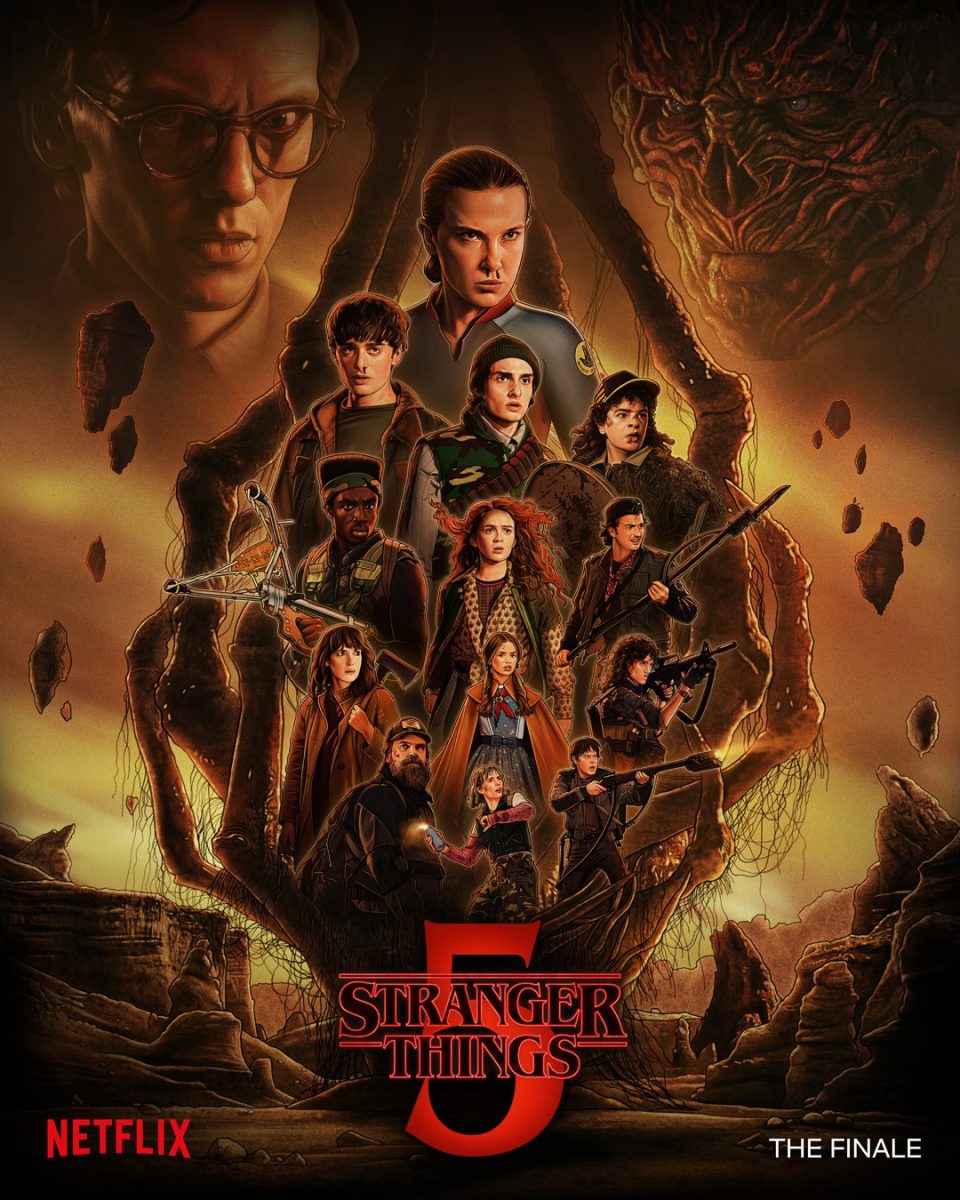
Premiering in 2016, Netflix’s “Stranger Things” is a show that many have grown up with. Anticipation for the final season was high as fans prepared to say goodbye to the beloved series, with expectations being even higher. While the finale of “Stranger Things,” released on Netflix and in theaters across the country on New Year’s Eve, was undoubtedly a success, many fans feel unsatisfied.
There were a few saving graces, such as the chilling performance by Jamie Campbell Bower as Vecna. Bower’s impressive range in his portrayal of the main villain of “Stranger Things” engaged viewers when other aspects of the show failed to do so. This, along with the large-scale special effects and massive constructed sets, demonstrated the few highlights of the finale.
The persistent nostalgia in the finale’s epilogue was also a success. With a focus on the characters’ future and a closing scene that directly parallels the opening of season one, viewers are almost inclined to believe that the show has been tied up neatly and beautifully — until, of course, they remember every dropped plotline and unexplained inconsistency.
There were endless questions in the finale left unexplained: Why were there no demogorgons in the Abyss, their native home? Why was Will Byers unharmed in the battle despite his established connection to the hivemind? What happened to the military and why did the other characters face no consequences for killing a considerable number of their men? These are just a few that many fans have been asking, receiving at most vague, half-answers in post-episode interviews with Matt and Ross Duffer, the show’s creators.
Not only were key points unexplained, but others were entirely unexplored. In the three years between the release of season four and season five, the creators of “Stranger Things” produced a stage play, “Stranger Things: The First Shadow,” which premiered on London’s West End and is currently on Broadway in New York City. The show explores the origin story of Vecna, also known as Henry Creel, and has been said to be accurate to the story of “Stranger Things.” However, the play establishes a number of things that many fans were disappointed to see missing from season five, including the fact that a young Joyce Byers and Jim Hopper knew Henry Creel in high school. The finale also fails to explain most of how Henry was taken over by the evil Mind Flayer, even directly contradicting certain facts from the play or erasing key components such as Patty Newby, Henry’s love interest and tie to humanity.
Another underexplored part of the season was Will’s connection to Vecna and the Upside Down, particularly in regard to the events of season one. With the first five minutes of season five being a flashback to a season one Will trapped in the Upside Down, fans expected the season to delve into how Will survived and why Will has remained tied to the Upside Down ever since.
The development of Will’s powers at the end of season five’s episode four, “The Sorcerer,” — the highest rated episode of the entire show — was also essentially brushed aside. Will only had two instances where he tapped into his newfound powers, which were given little explanation and did not raise him up to be the main character of season five, as the creators had claimed.
A more polarizing discussion among fans has been the relationship between Will and Mike Wheeler. Throughout season four, Will’s feelings for Mike became a focal point of his character, and his queer identity continued to be crucial to his storyline in season five. However, many fans were disappointed in its conclusion. His coming-out scene, situated awkwardly just before the final battle, was in front of nearly every character in the show. It was said to have occurred because of a vision Vecna showed to Will in an attempt to use his fear against him, though this vision was never shown to the audience and left many viewers confused about the purpose of Will’s coming out. Not only did the scene feel forced and impersonal, but it diminished Will’s feelings for Mike to a simple hallway crush rather than a crucial and complex component of his character as had been established thus far.
Not only was Will’s storyline carelessly closed, but the narrative written for Robin Buckley and Vickie Dunne was equally disappointing. For most of season five, their relationship was used only to support Will in his unsatisfying self-acceptance arc. Their ending was also ambiguous, with an off-screen breakup being hinted at in the epilogue. This was unnecessary and unsatisfying, failing to serve any purpose other than an apparent refusal to give the show’s queer characters a happy ending, a pattern that is far too common in mainstream media.
As a show whose first season found success in its dark, small-town mystery, the obnoxious grandiosity of this final season felt overwhelmingly inauthentic. Although the expansion of the “Stranger Things” world was inevitable as seasons progressed, somewhere between the AI-generated-sounding dialogue and half-baked storylines of season five, the heart of the story stopped beating. While seasons one and two — both written, produced and released within two years — were enveloped with intimately woven character moments, intriguingly complex sci-fi mystery and a strong message of love conquering fear, the final season — despite taking over three years to make — felt arid of this intention. Much of this disconnected feeling can be attributed to the overexposure of newer characters in this finale.
The “replacement” for the deceased Dr. Brenner, Dr. Kay’s storyline is not only completely isolated from the rest of the plot but provides little explanation about the Upside Down, Vecna or the military presence in Hawkins. Another character introduced this season was Holly Wheeler. Alongside Derek Turnbow and ten of their classmates, they found themselves kidnapped in Vecna’s mindscape, with Holly working to help them all escape. This is another example of a plot that is never fully tied up (Why Holly? Why 12 kids?). It also stripped other, more beloved characters away from the screen.
Holly’s older brother, Mike, who has undoubtedly been one of the most central characters throughout the show, was completely sidelined. Relationships like Jonathan and Nancy were left to falter, while fan-favorite dynamics like Eleven and Max or Will and Jonathan were completely ignored. As a result, this new abundance of characters shelved out the core characters that made “Stranger Things”, “Stranger Things” in the first place. Leaving such central characters without a satisfying arc concludes them as underwritten and misaligned with the original intent of the show.
One of the strongest criticisms of the finale was its confusing and harmful messaging. Firstly, the “big bad” Mind Flayer battle that had been built up to the whole show was far too quick and easy, falling short of the supposedly high stakes tied to this alternate dimension. Secondly, Eleven’s death became not only predictable after its implication in episode seven, but immensely fruitless. Her entire character arc built on dealing with abuse, feeling like a weapon and gradually finding her own identity, was completely abandoned through her choice to stay in the Upside Down and inadvertently end her life. This writing choice perpetuates harmful notions that the only way to end a cycle of abuse is to end one’s life, emanating negative outcomes onto a younger audience.
There was also much confusion about whether she truly died with the final “I believe” scene insinuating otherwise. However, despite originally adhering to this line of ambiguity, the Duffers later went on to explain that it would have been impossible for her to survive in an interview with Deadline. These post-finale interviews given by the Duffers have only added fuel to the fire of strife amongst the fandom. When asked about all the plot holes and loose ends, the majority of their responses either contradicted earlier establishments or stated that character resolutions happened “off-screen.” By conceding this, the show slipped from television’s most sacred rule: to show and not tell.