












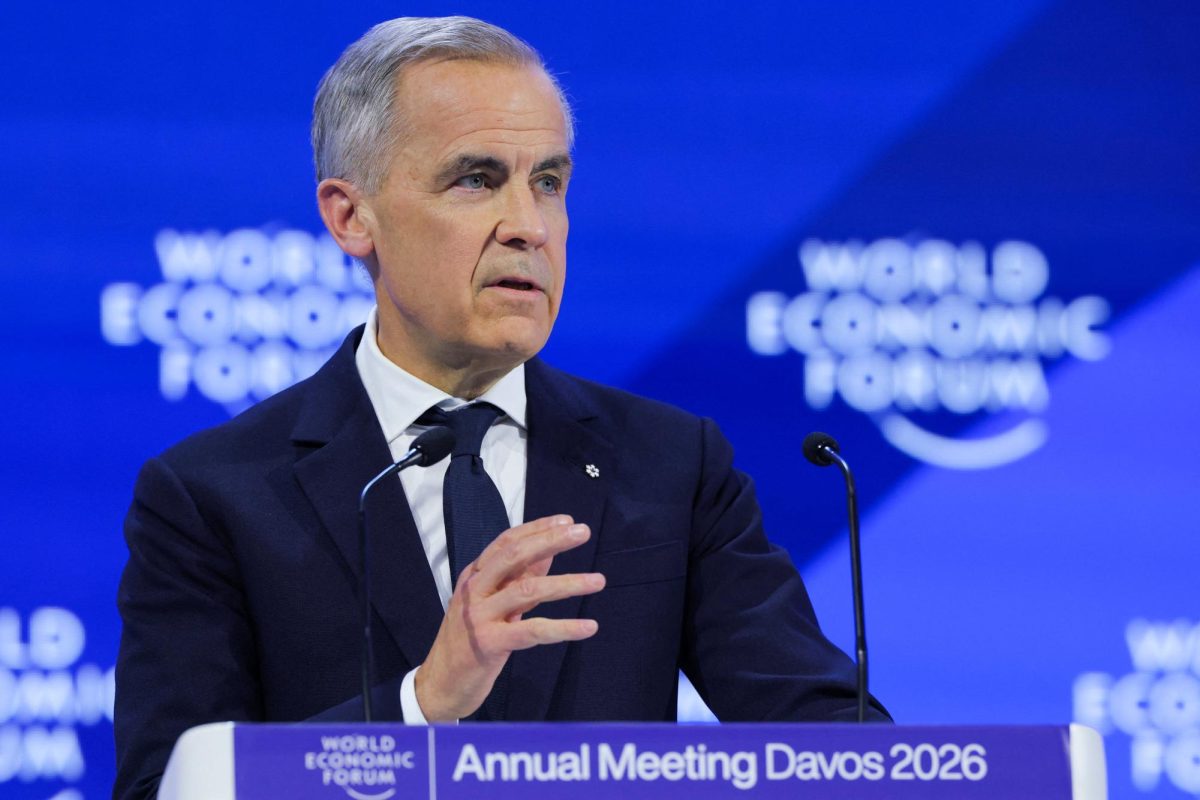

The speech received a standing ovation from an audience of global business leaders, heads of state and high-ranking officials for addressing worldwide tension that many felt, but most others feared to speak on.
The World Economic Forum (WEF) hosted its annual Davos, Switzerland summit from January 19-23. One of the largest and most significant gatherings in the organization’s history, this year’s conference proved to be especially revealing. It emphasized the changing relationship between the U.S. and its European allies, specifically regarding American intervention in Greenland, a key point of contention coming into the summit.
The WEF convenes each year in Davos to bring together leaders in business and politics from around the world. It allows for the creation of national and worldwide agendas for industry and commerce and a roadmap for the future, especially through worldwide challenges. Much like the United Nations and other international non-government organizations, the WEF does not make enforceable laws but instead provides recommendations on what policies should be focused on by international lawmakers.
President Donald Trump first expressed interest in the U.S. purchasing Greenland during his first term in 2019. Though this interest seemingly diminished as time went on, a sudden flare-up occurred in January of 2026, when Trump suddenly viewed the Arctic island as a vital possession for national defense and security.
In January, Trump had threatened to increase tariffs on eight European nations in an effort to gain leverage and strengthen his quest for Greenland. The existing 10% rate was set to rise to 25% in June if these countries did not comply with his desires. British Prime Minister Keir Starmer and French President Emmanuel Macron have both publicly deplored Trump’s use of tariffs on allies, claiming that they are unproductive and “unacceptable,” According to CNN.
Trump had also previously mentioned the possibility of American military intervention in Greenland, refusing to rule out an invasion of the island to establish control. This opened up questions around article five of the North Atlantic Treaty Organization’s (NATO) founding document, which states that an armed attack against one member will be defended by all others. This clause was clearly never set up with the idea that one ally would be attacking another, leading to important questions around how such a forceful intervention would look.
In his January 21 Davos speech, Trump backed off on most of these claims. Assuring European nations that he would not use military force to take Greenland, Trump said, “People thought I would use force…I won’t use force.” He also paused the tariff increase set to occur on eight allied countries, leaving the rate at the previous 10% level.
During his speech, the president proposed a new solution, an offer for the US to buy the island from Denmark for $700 billion. He cited national security interests, saying that the US needed Greenland “for world protection.” In his eyes, a more militarized Greenland under the control of the US would help to keep NATO safe from both Russian and Chinese threats. Greenland sits at an advantageous position near the North Pole, located directly on the shortest route between Russia and the US, or between China and Europe.
Since the conference at Davos, interest in Greenland has partially died down, as the US president has weakened his actions in pursuit of the territory and instead has focused more on long-term militarization through NATO, a much more stable and sustainable option.
The day before Trump’s speech about Greenland, on January 20, Canadian Prime Minister Mark Carney delivered a speech about the “rupture” that he saw taking place in the world order. Taking place in both French and English, it emphasized unity between the “intermediate powers” of the world, specifically Europe and Canada. While not directly addressing the US, the overall message was clearly meant to deplore increasing US influence beyond its own borders in Greenland, Venezuela, and around the world through tariffs.
The main theme of Carney’s speech was the mounting changes taking place in what he referred to as the “rules-based international order.” He said that nations can no longer blindly rely on international organizations like the U.N., WTO and others to support all nations equally, and instead must adjust their focus to strategic autonomy, keeping in mind the interests of their people. “Complacency will not buy safety,” Carney stated, regarding this need for a change in focus. He also called for smaller nations to refuse to live in the shadow of larger ones, instead focusing on the shared values that have unified them in the past.