





![Dec 21, 2024; Orlando, Florida, [USA]; Tiger Woods hits out of the bunker on the fourth hole during the PNC Championship at The Ritz-Carlton Golf Club.](https://spectator.lfanet.org/wp-content/uploads/2026/04/2026-04-03T174851Z_1_LYNXMPEM320LZ_RTROPTP_4_GOLF-1200x800.jpg)





Can hateful words provoke hateful actions? In the United States, a country that values and wrestles with democracy everyday, freedom of speech becomes increasingly important. Our society needs to prioritize the freedom of democracy, and to do so, we must exemplify speaking freely without causing danger. In an era of a global pandemic, climate change, heated global politics and violent and public wars, the ability and reasons to hide behind a screen and spread hateful words become increasingly available.
Hate speech: “Abusive or threatening speech or writing that expresses prejudice on the basis of ethnicity, religion, sexual orientation, or similar grounds.” This is how Oxford Languages defines the term. The American Civil Liberties Union (ACLU) only declares speech as “hate speech” when it “vilifies, humiliates or incites hatred” – not just the expression of prejudiced words, but the dangers of it. The United Nations counts “insults” in their definition of hate speech. Political philosopher John Stuart Mill defines the “harm principle” as the idea that people should be free to act as they wish as long as their actions do not cause harm to others. Where can the line be drawn between free and hate speech? How much power do our words yield?
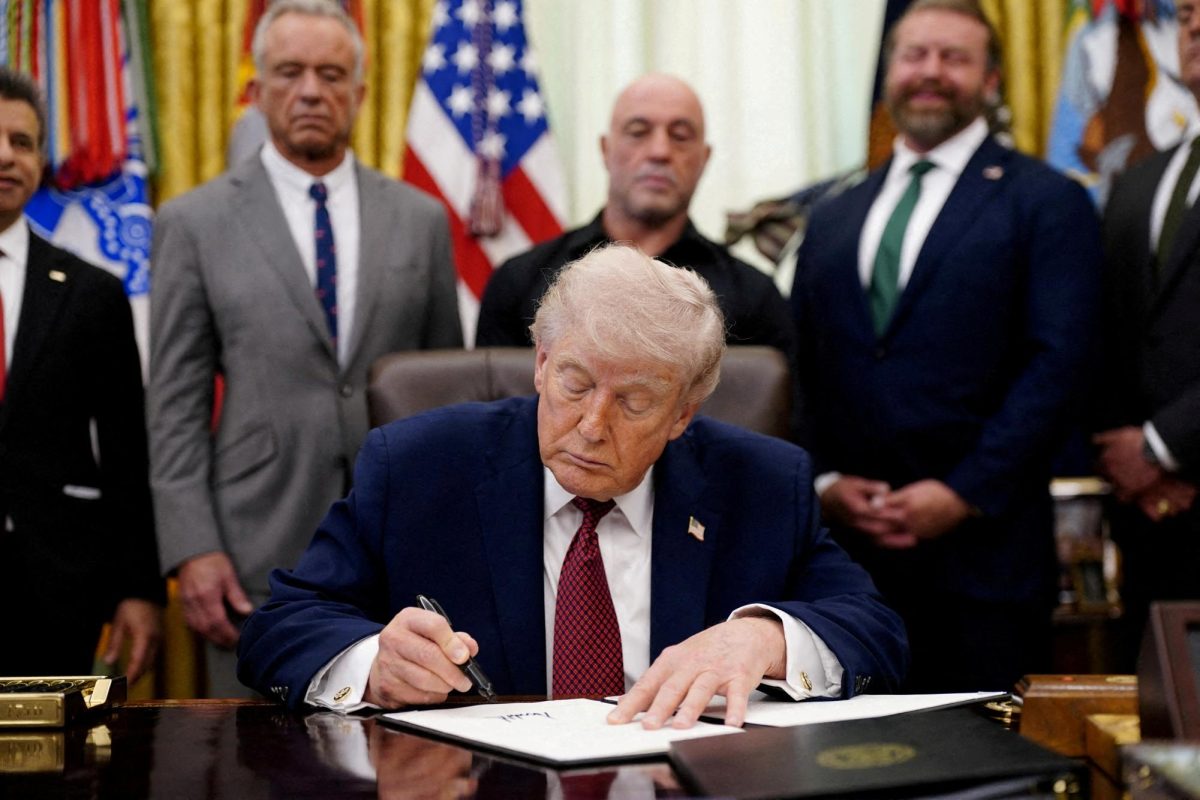
COVID-19 caused a massive influx of anti-Asian xenophobia when public figures such as President Trump referred to the deadly disease as the “Chinese virus” or “Asian virus.” The blaming of deaths around the world on one country or one ethnicity fostered prejudice mixed with misinformation, leading to an increase in anti-Asian hate crimes. According to the Anti-Asian Hate Crime Report (2021), these crimes increased by 145% from 2019 to 2020 in the 16 largest cities in the U.S..
Because Trump’s words cannot directly be traced to crimes, there is no clear declaration of “hate speech,” and he is not liable for the crimes. Ed Yohnka, Director of Communications and Public Policy at the ACLU, explained that though Trump’s language is often vitriolic, “generally him being derogatory towards a group of people is not something that is actionable,” aligning with his definition of free speech: “free speech is anything that does not cause direct and imminent harm to another person.” This is what makes the term so difficult to generalize — crime cannot often be easily identified as a product of speech.
The duty to act responsibly when given freedom of speech falls on each individual. However, the value of democracy outweighs individual responsibilities, granting the right that each person deserves to speak controversially without the threat of violence or intimidation. So, Trump was able to call COVID the “Chinese virus” without legal repercussions. The same case applied to a group of Neo-Nazis in Skokie, Illinois.
Despite the antisemitic and racist words spewed by a group of Neo-Nazis, the ACLU intervened to protect the Nazis’ right to free speech, prioritizing the commitment to democracy over a commitment against racism and antisemitism.
In 1977, the ACLU sent a group of lawyers to represent Nazis and their freedom to hold a demonstration in a nearly half-Jewish village with hundreds of Holocaust survivors. One of those ACLU lawyers, David Goldberg, a notably Jewish man, published about his experience, praising the “ACLU’s fierce commitment to the principle that freedom of speech is a universal right no matter how offensive the message or the speaker.” Goldberg’s ability to actively work for the rights of people speaking out against Jewish people, such as himself, makes him an example of the dedication to free speech for which our society should strive.
On LFA’s own Spectator staff, debate occurred when reviewing an album by Kanye West. The student writing the review praised his musical abilities, rating an old album of his a “10/10.” We, the staff, debated on putting up a potential disclaimer to acknowledge the artist’s antisemitism and stating that the staff does not align with his values. We chose against the disclaimer, prioritizing an honest review of the art, not the artist – we separated his hate speech from the reviewer’s free speech. Kanye’s antisemitism was hate speech, directing a mob of his supporters to his website with swastika shirts through a superbowl commercial, his song titled “Heil Hitler,” his public statements that praised Hitler’s contributions to society (therefore praising the holocaust), and finally posting on the social media platform “X” that he was going to go “death con 3 On JEWISH PEOPLE” – a clear threat to a group of people, officially crossing the line from free speech to hate speech.
“We get caught up in using this idea of hate speech against speech we don’t like,” Yohnka explained, “We either have to protect speech for everybody or have it for nobody.” He went on to explain that today, young people have somehow been taught that everything is supposed to be safe and there aren’t differing thoughts – “the world isn’t supposed to be that way.” The prioritization of a free democracy needs to grant people the opportunity to speak their minds in order to create a continuously free world.